
Reviewed in full · WALKING TOURS IN PALERMO
Discover the Charm of Palermo: A 3-Hour UNESCO Sites Walking Tour
Palermo is one of the few European cities where you can walk a straight line through layers of empire, trade, and faith, all in a compact core. This 3-hour UNESCO sites walk is a smart way to see Palermo’s Norman-Arabic and baroque highlights without burning an entire day on logistics. I love that you get both big monuments and the lived-in street scenes, and I also love the practical payoff, Cathedral entry plus a Sicilian cannolo or granita. The one thing to keep in mind is that the timing is tight, and a few of the most famous interiors are mainly viewed from the outside during this tour.
You’ll usually hear the story in clear English, and the guide factor matters a lot here. In particular, guides such as Valeria, Peter, Renata, and Fabio show up in the kind of feedback that signals you will actually understand what you are looking at, not just stand near a wall and nod. Even on cold or rainy days, the pace stays workable, and the group stays small (max 20), which helps with questions.
If you are hoping for lots of deep entry time into every UNESCO interior, adjust your expectations first. The Cathedral stop includes entry, while other marquee spots are about exterior views and context, including the Palatine Chapel mosaic story from nearby.
Quick wins on this 3-hour UNESCO walk
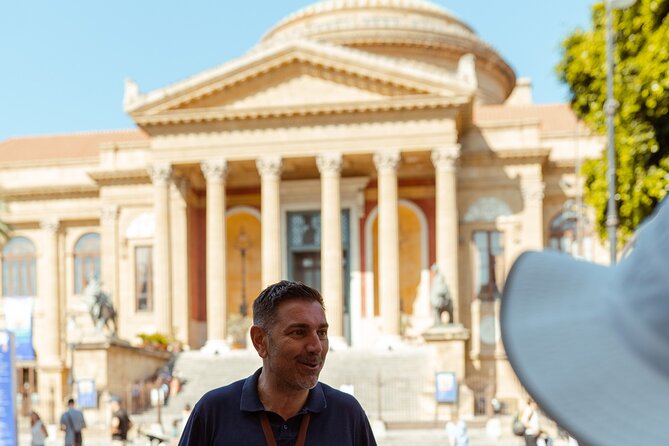
- Opera-house stop with perfect-acoustics bragging rights at Teatro Massimo
- Norman-Arabic architecture context that ties together the Cathedral and the Palazzo dei Normanni area
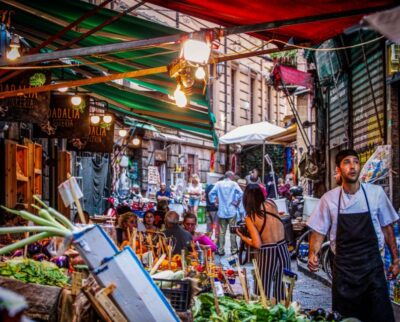
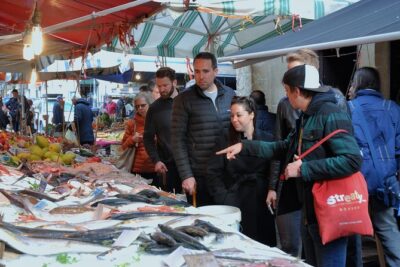
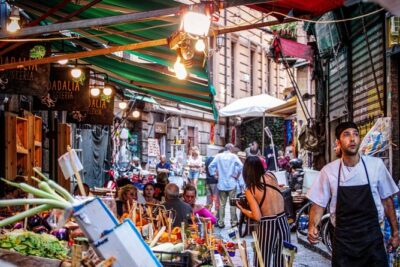
- Market wandering through Via Bandiera and Piazza Caracciolo, with real street-food vibes
- Baroque-to-Florentine fountain details at Garraffo Fountain and Piazza Pretoria
- A must-see city geometry lesson at Quattro Canti, built 1608 to 1620 and finished later
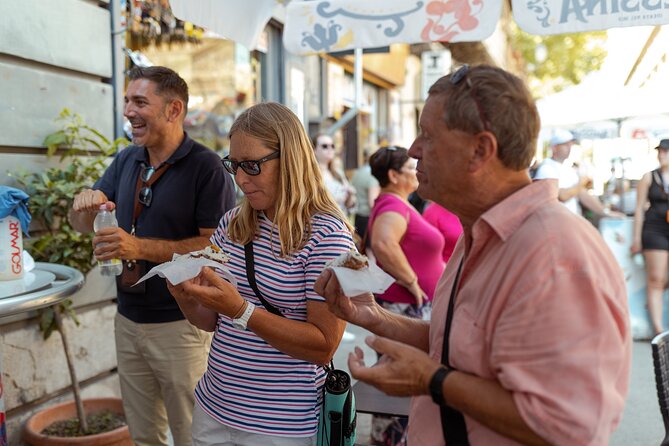
- A food finish with a typical cannolo or granita that keeps the tour from feeling like homework
Palermo in 3 hours: Norman-Arabic layers you can actually see
Palermo’s best trick is that history doesn’t sit politely behind velvet ropes. It sticks to the buildings. You walk from Norman-era architecture into Greek-Byzantine Christian traditions, then around baroque squares and Ottoman-era (or at least Islamic-era) influences that survived long enough to leave physical marks.
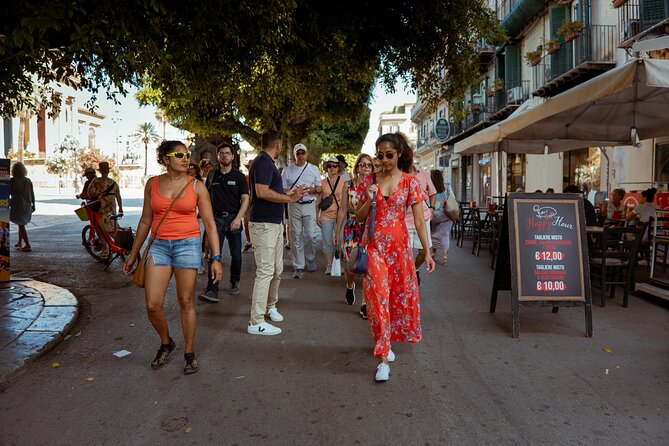
This tour is built for orientation. In about three hours, you get the idea of how Palermo formed, why the architecture looks the way it does, and where the major “you should go back later” stops sit in relation to each other. That matters because Palermo’s center is busy, narrow, and easy to get turned around in. A guide helps you connect streets to stories fast, instead of guessing.
More Walking Tours in Palermo
- Palermo: NO Mafia Walking Tour
★ 4.8 · 2,431 reviews - Palermo Original Street Food Walking Tour by Streaty
★ 5.0 · 2,105 reviews - Palermo: Street Food and History Walking Tour
★ 4.9 · 1,294 reviews
Price and what you actually get for $31.88
At $31.88 per person for a roughly 3-hour walk, the value is strongest if you care about two things: interpretation and at least one included interior. Here, you get a licensed English-speaking guide, time with the Cathedral (entry included), and a typical Sicilian cannolo or granita.
That combo is what makes the price feel fair. Many walking tours in big historic cities are mostly outside viewing. This one adds one meaningful interior stop, and it also saves you time by bundling the guide and the Cathedral visit into one plan.
You also get mobile ticket convenience, and the tour is capped at 20 travelers, which tends to keep it from feeling like a school field trip. Expect a walk with breaks, not a nonstop sprint.
Teatro Massimo to the Galleria: opera, faded glamour, and city rhythm
The walk starts at Via Volturno and soon drops you into central Palermo’s big-street energy, beginning at Piazza Verdi. The headliner here is Teatro Massimo Vittorio Emanuele, Palermo’s opera house and, at the time of its opening, one of Italy’s largest. What I like about this stop is that it gives you a sense of how serious Palermo has always been about culture and public life, not only religion.
From there you move toward the Galleria delle Vittorie, a structure that was once intended as a commercial mall. Over the decades, the building has deteriorated, and restoration has been attempted. It is a useful reminder that cities change. Even when architecture fades, the bones still shape how you read the street.
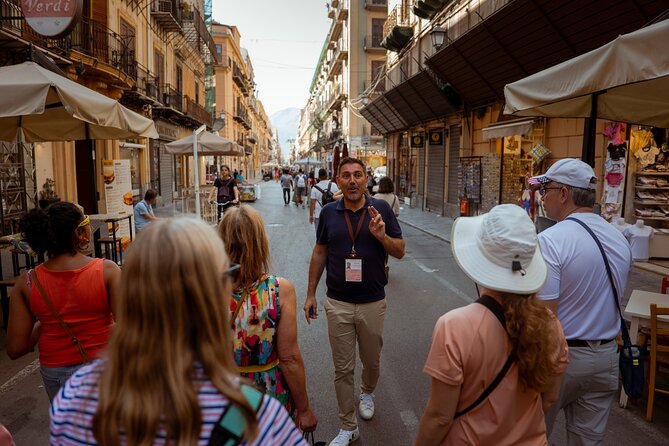
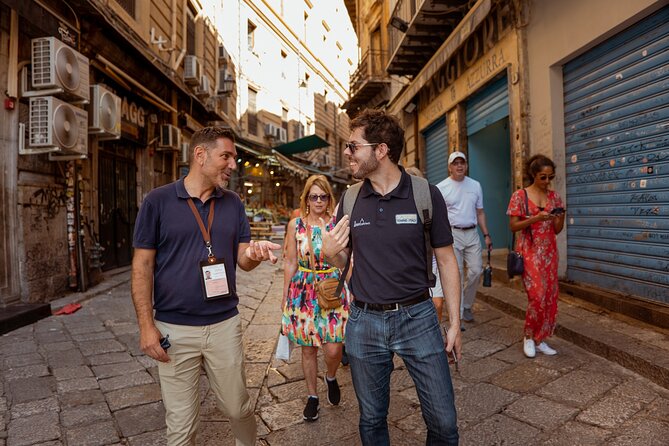
Then you head into the market-facing streets, crossing near Via Bandiera, where the open-air market atmosphere shows up right in your path. If you have never wandered a Southern Italian market on foot, this is a good “first exposure” moment. You see what daily life looks like, not just what monuments look like in postcards.
San Domenico and Piazza Caracciolo: where Palermo’s pride shows up in stone
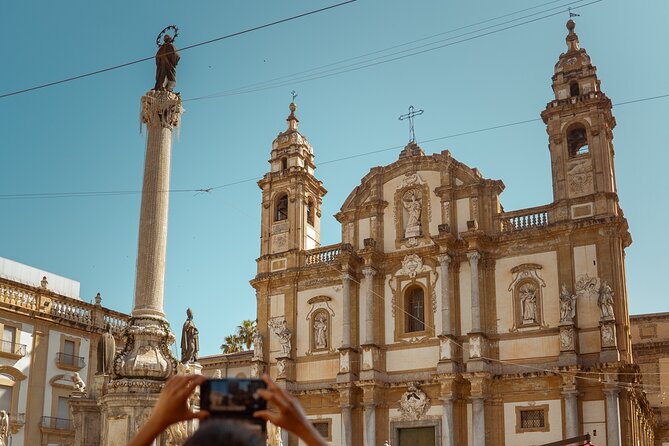
Chiesa di San Domenico is one of those churches that makes you slow down without anyone saying to. It dominates the homonymous square, and it carries big symbolism. It is also described as a kind of Pantheon for illustrious men of Sicily, and it is considered a church symbol in the fight against the mafia.
That “stone as statement” angle is why this stop works. The guide ties art and architecture to real social meaning, so the church feels less like a museum piece and more like a landmark that residents still relate to.
Next comes Piazza Caracciolo and its market lanes. The area is linked to the old name la Bucceria, tied to the French idea of boucherie, butcher’s shop. Translation: this is a place built around trade and food. You’ll get the street-food energy in a way that helps you later when you are choosing where to eat on your own.
Two small but practical notes for this section:
- It can get crowded in active market lanes, so keep your phone secured while you look.
- If you need a restroom later, you may want to plan ahead, because Palermo can be tricky for them when you are deep in the center.
A different sort of day out around Palermo:
- Palermo: Hop-on Hop-off Bus Tour 24-hour Ticket
★ 3.9 · 2,410 reviews - Segesta, Erice and Salt Pans Full-Day Excursion from Palermo
★ 4.2 · 1,791 reviews - Palermo: Teatro Massimo Opera House Guided Tour
★ 4.5 · 1,573 reviews - From Palermo: Monreale and Cefalù Half-Day Trip
★ 4.2 · 1,354 reviews
Garraffo Fountain, the Stock Exchange, and Palermo’s “power in plain sight”
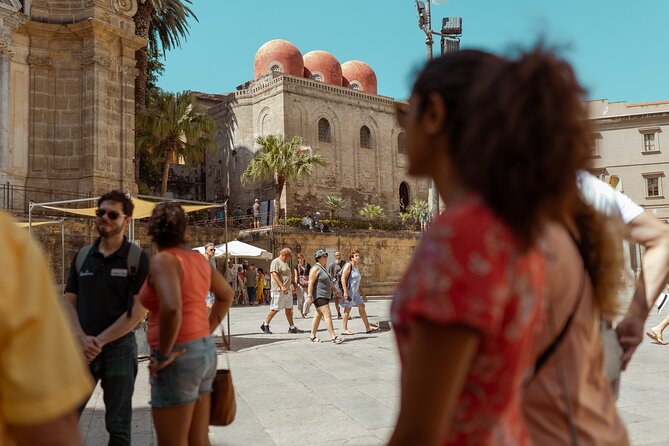
Moving away from the church square, you pass the Garraffo Fountain in Piazza Marina. It is baroque, and the guide’s job is to show you what baroque fountains usually do beyond looking fancy. They signal wealth, status, and the ability to commission major artists and stonework.
You then reach the story of the Palermo Stock Exchange. It is easy to miss this kind of layer if you only chase cathedrals, but it is part of Palermo’s long economic identity. The exchange opened trading in 1845, and it lived for about a century in the Palazzo delle Finanze. Until 1997, the exchange existed as one of ten active Italian stock exchanges, and there were other Sicilian exchanges too, such as Messina, Catania, and Agrigento until World War I.
The point for you is not the finance trivia. It is the shift in the city’s role over time. When a city can hold onto multiple identities, you see it in its architecture and in where the “institutions” were placed.
The Descent of the Judges and La Martorana: politics, language, and faith in the streets
A highlight here is the descent known as the Judges. It runs from Piazza Sant’Anna to Piazza Bellini and used to be called calata dei giudici. The street name points to the Judges of the Praetorian Court, people tied to Palermo’s governance. The guide can connect the street’s position and naming to how legal and political power worked, including that judges were elected for one year.
Then you reach Santa Maria dell’Ammiraglio, also called La Martorana. This is one of the best stops for anyone who likes religious history with actual cultural crossover. Built between 1143 and 1185 by George of Antioch, it is connected to Greek-Byzantine clergy and ceremonies in ancient Greek or Albanian language. The church is linked to the Eparchy of Piana degli Albanesi of the Italo-Albanian Catholic Church.
You can feel why this matters. Palermo was not one single culture wearing one single costume. It is more like a layered mosaic, and La Martorana is one of the places where the language and ritual tradition is part of the visible identity.
Piazza Pretoria and Quattro Canti: fountain drama and street-corner math
Piazza Pretoria is near the edges of Kalsa, close to the corner of Cassaro with Via Maqueda and a few meters from Quattro Canti. This square is famous not because it is loud, but because it is weird in a very controlled way. The fountain was created for Don Luigi de Toledo’s garden in Florence, and Palermo’s version ties in a story of land pressure, a garden plot held by nuns, and commissioning of the fountain to a Florentine sculptor.
It is also a good “pause and look” moment. If you have ever wondered why European cities love formal squares, this one gives you a reason.
Then comes Quattro Canti, also known as Piazza Vigliena. It is one of Palermo’s most popular stops for a reason: it is visually theatrical. The four buildings were built between 1608 and 1620, and sculptures and decorative elements were completed later in 1663. Standing there, you can see how the city organized its quarters and how architecture staged the intersection like a stage set.
Practical tip: use Quattro Canti as your orientation anchor. The guide often uses this spot to explain how to walk back later and where other major streets lead.
Cattedrale di Palermo: Norman architecture with a timeline built into columns
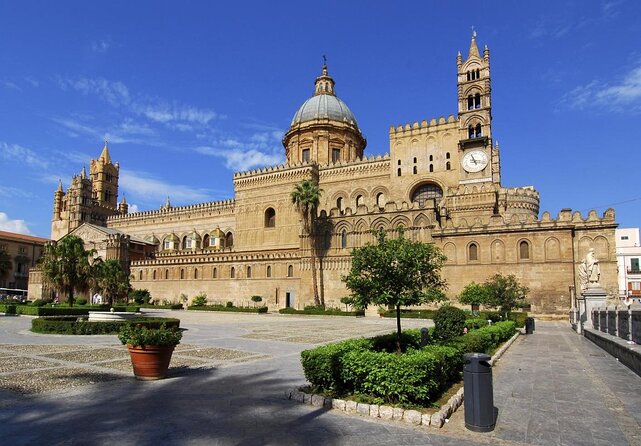
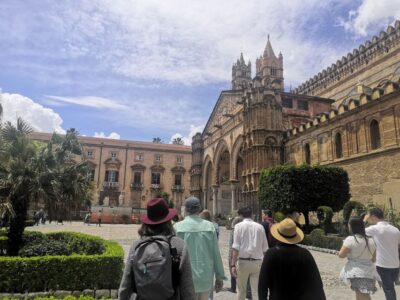
This is the included interior stop, so do not rush it. Cattedrale di Palermo is a Norman architectural treasure in Sicily, and it was built in 1184 as a converted Christian church on a site that previously held a mosque, and earlier even a Christian basilica.
What makes it feel alive is the layered styles across centuries. Gothic and medieval elements show up alongside Arabic influence, and the guide points out that an actual passage from the Koran is engraved on one of the columns. Later styles also appear, including neoclassical touches. It is basically a stone timeline.
The tour also gives you the competition story between Palermo’s cathedral and Monreale, which helps explain why some decorative choices feel like they are trying to outshine the next place. If you like context, this is a strong stop.
Plan to spend your 30 minutes well. Go in with a simple goal: find one feature that feels Norman, one that feels Arabic, and one that feels later. That way, the variety becomes a pattern, not just visual noise.
Villa Bonanno garden: mosaics you can spot, and mosaics you should go see
Villa Bonanno sits in Victory Square, behind the Palace of the Normans. The garden is always open and includes palm trees, plus statues and busts of famous Palermitans.
This stop is also a hint for what exists inside the broader museum ecosystem. Roman patrician houses with mosaics were found here. Notable mosaics include the Seasons and Orpheus, and these are now kept at the National Archaeological Museum.
In other words, even if you are not touring the museum today, you are getting a clue about why Palermo treats mosaics like a big deal. You are also getting a welcome break from constant crowding. Gardens in the historic core can feel like a reset button.
Palazzo dei Normanni and the Palatine Chapel mosaics from the street
The Palace of the Normans, Palazzo dei Normanni, is one of Palermo’s most extraordinary buildings, and it is the kind of place where the guide connects history through architecture rather than through dates alone. The complex chronicles Palermo’s history, from early Punic settlements up to later eras.
This is also where the Palatine Chapel comes into focus. Even if you do not have included admission here during your walking tour, the guide’s job is to prepare you to recognize what you will see if you go inside: Arab-Norman art and mosaic work that helped make the site a World Heritage designation since 2015.
You also get a quick look at Torre Pisana, associated with the Palermo Astronomical Observatory and the Specola Museum. Temporary exhibitions sometimes happen in Duke of Montalto halls, so your guide may mention that this is not only about ancient stone.
For you, the value of this portion is practical. If you decide to spend extra time in Palermo later, the tour gives you a starting point for which interior you want to prioritize and why.
Tips to make the short walk feel smooth, not hectic
Palermo is a busy city, and a 3-hour walking tour can feel like a lot if you go in unprepared. Here are a few smart moves:
- Wear comfortable shoes with good grip, because you will be on uneven historic surfaces.
- Bring water. Market areas can be warm, and the walking pace can feel quick even with rest stops.
- If you are sensitive to crowd noise, you will be glad this kind of tour often uses an amplification system/headsets so you can hear the guide clearly.
- Use your guide for food direction, not just facts. Many guides end with a cannolo or granita and also share where to go next.
And if you are disappointed by one short stop, remember the tradeoff. You are buying time efficiency. This tour is best when you treat it as your launchpad, then return on your own for the interiors that hook you the most.
Who should book this Palermo UNESCO walking tour, and who might want more time
This is a great pick if:
- You want an orientation tour on your first day.
- You like understanding how different cultures show up in architecture and street layout.
- You want one included interior, the Palermo Cathedral, plus time around markets and squares.
You might want a longer or different plan if:
- You are specifically chasing deep time inside the Palatine Chapel mosaics.
- You prefer slower, linger-and-draw-your-own-conclusions touring, because some stops are necessarily short to keep the full route manageable.
A small reality check: you will see a lot of “big names,” but each stop is a chapter, not a full book.
Should you book this Palermo UNESCO walking tour?
Yes, if you want the smartest “first impression” route through Palermo’s UNESCO-linked core. For the money, you get more than outside sightseeing: you get a licensed English guide, one included major interior, and a real local food finish. The route also makes it easier to plan your next two or three days because you learn where the landmarks sit relative to each other.
Book it early in your trip if you can, so you can use your new map of the city for later meals and repeat visits. If you are the type who gets satisfaction from connecting architecture to social meaning, you will probably love how this tour ties together churches, squares, and even street names like the Descent of the Judges.
FAQ
How long is the Palermo UNESCO walking tour?
It is about 3 hours.
What is the price per person?
The price is $31.88 per person.
Where does the tour start and end?
The tour starts at Via Volturno, 44, 90138 Palermo PA, Italy, and it ends back at the same meeting point.
Is it an English tour?
Yes, it is offered in English.
What tickets and entrances are included?
Cathedral entry is included, and the tour also includes typical Sicilian cannolo or granita. Other admissions are not included where noted.
Does the tour run in bad weather?
Yes, the tour takes place regardless of the weather.
Can I get a full refund if I cancel?
Yes. You can cancel up to 24 hours in advance for a full refund.
Just reviewed in Palermo
- Relax in Mondello and Sanctuary in Monte Pellegrino★ 4.4 · 70 reviews
- a PRIVATE ride of Favorita Park and Mondello★ 5.0 · 5 reviews
- Palermo to Siracusa: stop al Valley of Temples & Roman Villa★ 5.0 · 5 reviews
- Private tour: Segesta, Salt Pans & Erice★ 3.8 · 4 reviews
- Private Monreale Cathedral and Cloister, Ceramic Lab tour★ 5.0 · 5 reviews
- PHOTOSHOOT IN PALERMO★ 5.0 · 15 reviews
- Private Photographer Shooting + Sightseeing & Tasting Tour★ 4.8 · 4 reviews
- Palermo: Vintage Fiat 500 Sightseeing Tour★ 5.0 · 132 reviews
Walking Tours in Palermo, compared.
Palermo Original Street Food Walking Tour by Streaty
Read our review →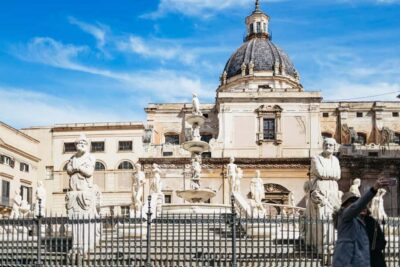
Palermo No Mafia walking tour: discover the Anti-mafia culture in Sicily
Read our review →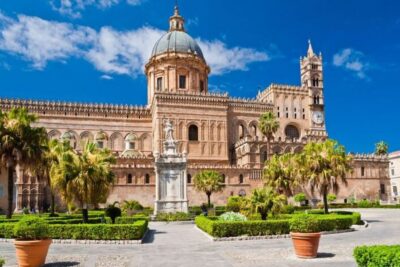
Street Food Walking Tour with Local Guide & Tasting
Read our review →
UNESCO World Heritage Sites Guided Walking Tour
Read our review →Browse the lists this tour appears in