

Reviewed in full · WALKING TOURS IN CATANIA
Catania Walking Tour with Audio and Written Guide by a Local
Catania has a talent for feeling layered, volcanic, and theatrical all at once. This audio and written walking tour is a smart way to stitch those layers together as you move through the historic center, with stories you can pause, replay, and take at your own speed. I especially like the easy-to-follow digital format that keeps you moving from stop to stop without needing to herd a group.
Two things I really appreciate: the guide covers a tight set of highlights in about 3 to 4 hours, and it gives practical context you can actually use on the street, including local restaurant advice. The main drawback is also the nature of self-guided tours, you need a smartphone with an internet connection, and you will miss the audio if your phone runs low on battery or you forget headphones (headphones are not included).
Key highlights at a glance

- Low price for a full historic-center circuit, plus most stops are free to enter
- Audio and text in multiple languages (English, Spanish, Italian, German, French)
- Flexible pacing because you can start, stop, and linger as you like
- Built-in routing support via Google Maps connection
- Smart local tips for food, not just monuments
- One paid add-on at the Roman amphitheater (ticket not included)
Why this Catania walk feels efficient and not rushed
This isn’t a “see everything at warp speed” tour. It’s built as a walking circuit that hits the core of Catania’s old town, then lets you breathe between major landmarks. That matters because Catania’s best moments often happen in the gaps, at a street corner, in a doorway you almost walked past, or looking back at lava-stone architecture after you’ve turned the corner.
You’ll get a digital guide that mixes audio with written info, and you can use it as you go. That flexibility is exactly why a lot of people rate this highly. It also means you can customize the route around what you care about most, and you can spend extra time where your curiosity pulls you in.
For best results, treat this like a “learn while walking” plan. Even if you only catch half the details, you’ll still come away with a clearer sense of what you’re looking at, and why it’s there.
More Walking Tours in Catania
- Catania: Heart of the City Guided Walking Tour
★ 4.6 · 708 reviews - Catania: City Highlights Walking Tour
★ 4.7 · 666 reviews - Catania: Street Food Guided Walking Tour
★ 4.9 · 326 reviews
Route plan: from Ursino Castle to San Nicolò l’Arena
The experience starts at Ursino Castle (P.za Federico di Svevia, 21) and ends at Benedictine Monastery of San Nicolò l’Arena (Piazza Dante Alighieri, 32). Because the guide is self-paced, you can decide how long to stop at each location within the walking flow.
You should plan for about 3 to 4 hours total, depending on how long you linger and whether you add the Roman amphitheater ticket. The tour also has a maximum group size listed (up to 104), but since it’s digital, your day mostly depends on you, your phone, and your comfort with walking.
Timing note: every stop includes a suggested time window. That’s useful when you’re trying to manage your day, like squeezing this in before lunch or after a museum visit.
Stop 1: Ursino Castle and the story of lava-stone defense
Stop duration: about 1 hour. You begin at Ursino Castle, a fortress tied to Frederick II of Swabia. Even before you read any detail, the setting tells you it was built for protection. Originally, the castle was closer to the sea, protected by defensive structures and moats, and the walls were made with carefully cut lava-stone ashlar.
What I like about starting here is that it gives you a baseline. Once you see the castle’s stonework and defensive design, the rest of the historic center makes more sense. You understand that Catania’s architecture isn’t just pretty, it reflects centuries of survival in a volcanic and seismic landscape.
Practical tip: since the stop time is the longest on the route, use it to orient yourself. If you’re going to get lost, it’s usually because you haven’t built a mental map first. Ursino Castle is a good “anchor point” for that.
Stop 2: A’ Piscaria (Pescheria) fish market in the old center
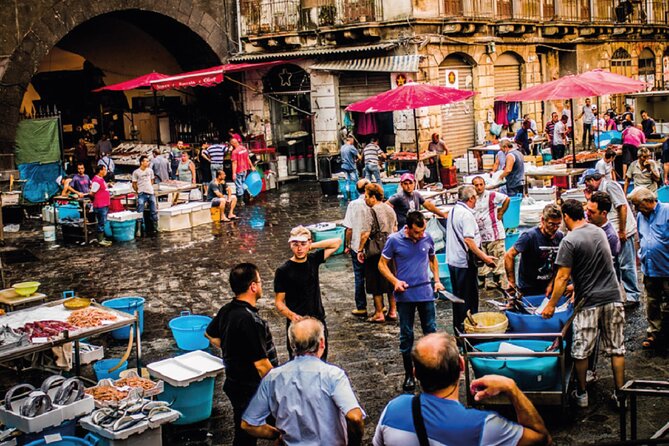
Stop duration: about 20 minutes. Next you head to A’ Piscaria, the Pescheria, Catania’s famous fish market. It sits in the historic center near Piazza del Duomo and the Fontana dell’Amenano.
This is the kind of place where the details matter. Fish markets can be noisy and hectic elsewhere, but here you’re in the middle of old-town rhythms. The guide also connects the market’s local name, Piscarìa from Sicilian dialect, to how the city talks about itself.
What to do here: don’t rush. Spend a few minutes watching how people move through, then use the guide’s context to interpret what you see. You can treat it like a living street museum, with smells and sounds doing half the storytelling.
A different sort of day out around Catania:
- Catania: Mount Etna Morning or Sunset Day Trip with Tasting
★ 4.8 · 4,028 reviews - Catania: Sunset Jeep Tour of Mount Etna and Lava Flow Caves
★ 4.8 · 2,113 reviews - Mount Etna: Trek to 3000m with cable car and jeep
★ 4.7 · 1,978 reviews - Sicily: Etna and Alcantara Gorges Full-Day Tour with Lunch
★ 4.8 · 1,766 reviews
Stop 3: Fontana dell’Amenano, the underground river connection

Stop duration: about 10 minutes. Then comes Fontana dell’Amenano, created in 1867 by sculptor Tito Angelini, in Carrara marble.
This fountain is dedicated to the Amenano, the underground river that runs under the city of Etna. It’s a quick stop, but it’s meaningful, because it links Catania’s water story to the city’s volcanic reality. You get a sense that nature is always in the background, even when you’re looking at something built and decorative.
Tip: pause for a minute even if you’re in a hurry. This is the kind of detail that makes photos better, because you’re capturing something with context, not just stone and water.
Stop 4: Piazza del Duomo, Catania’s emotional center

Stop duration: about 20 minutes. Now you’re in Piazza del Duomo, the heart of Catania’s historic center. The square is where the city gathers and where major landmarks crowd in.
This stop is especially valuable because it connects the practical and the iconic. You’re near the Cathedral of Sant’Agata (also called Catania Cathedral), and the guide frames the cathedral’s role and dedication to Sant’Agata, the city’s patron saint.
How to use this moment: take ten minutes to look up at the cathedral facade area, then look out across the square and get the lines of sight. That way, when you step closer later, you’re not seeing a building in isolation. You’re seeing it as the “main character” in the square.
Stop 5: Basilica Cattedrale di Sant’Agata, Baroque after 1693
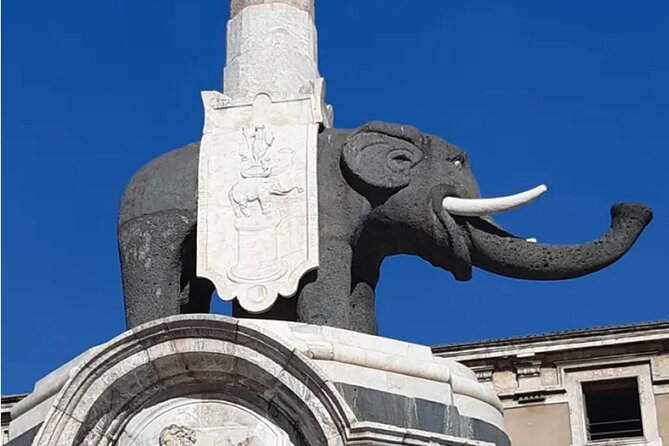
Stop duration: about 20 minutes. Here you visit Basilica Cattedrale di Sant’Agata, an important Baroque example in Catania.
The guide highlights a powerful timeline: the cathedral was built in 1090 on the remains of an ancient Roman temple dedicated to Jupiter, then it was rebuilt after the 1693 earthquake, which destroyed much of the city. That single sequence explains why Catania can feel both ancient and reborn at the same time.
Why this stop is worth your time: it’s one of the best places on this walk to understand how catastrophe reshapes a city’s identity. You’re not just viewing an architectural style. You’re seeing the aftermath of history turned into stone and ornament.
Stop 6: Piazza Università and four bronze legends
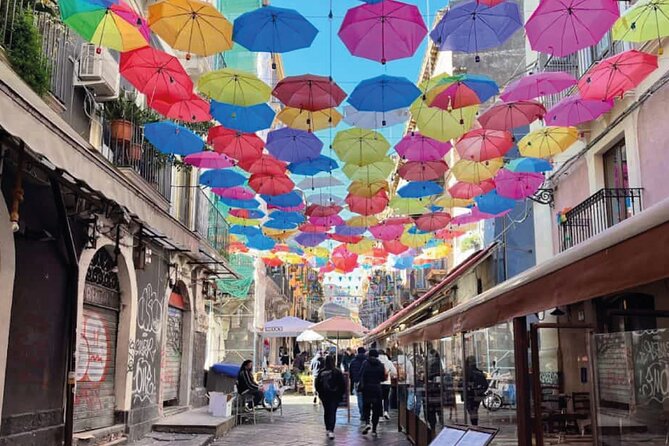
Stop duration: about 10 minutes. Next is Piazza Università, named for the Palazzo degli Studi, also known as Palazzo Università. The standout feature here is the set of four bronze lampposts at the corners, each representing figures from local legends.
The guide names them: Gammazita, the young; Cola Pesce, the sailor with underwater skills; and the brothers Anfinomo and Anapia, plus the legendary Catania paladin Uzeta.
Even if you don’t remember every name, the effect sticks. You end up noticing the street furniture like it’s part of the storytelling. That’s the difference between “passing by monuments” and actually feeling where the city’s myths live.
Quick tip: snap a photo, then read the legend again on your screen. It makes the imagery click.
Stop 7: Anfiteatro Romano under Piazza Stesicoro (ticket extra)
Stop duration: about 25 minutes. Beneath Piazza Stesicoro lies an ancient Roman theatre dating to the 1st century BC. It’s submerged through centuries of Etna eruptions and seismic events.
Important detail: the Anfiteatro Romano ticket is not included and is listed at 4€. The guide notes that you are not going inside as part of the stop, but you can visit it yourself if you want.
How to decide: if you’re the type who likes Roman layers, add the ticket. If you’d rather keep the walking flow smooth, you can use this time to absorb the atmosphere and continue.
Stop 8: Via dei Crociferi, a cinematic street
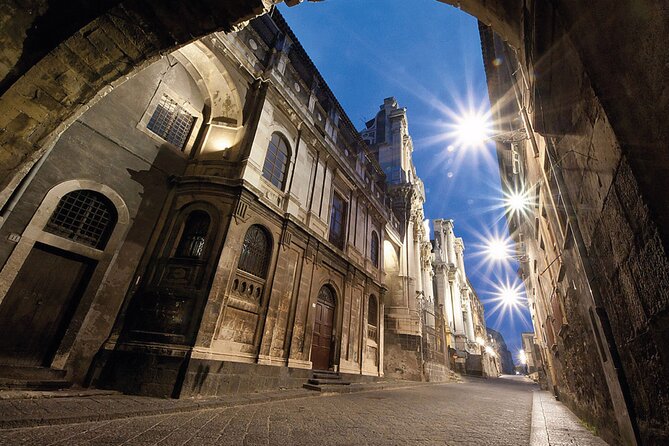
Stop duration: about 10 minutes. Via dei Crociferi is one of the oldest streets in Catania, known for its beauty and often used as a film set.
This is a short stop, but it’s a good reset point. Streets like this are where Baroque and everyday life meet. You’re not trapped inside a monument, you’re moving through the same corridors people have walked through for generations.
What I’d do: take a few steps slower than you think you need to, and look for the building perspective lines. Many streets look great straight on and even better after you’ve walked past and turned back.
Stop 9: Benedictine Monastery of San Nicolò l’Arena, the finish line
Stop duration: about 30 minutes. Your tour ends at the Benedictine Monastery of San Nicolò l’Arena in Piazza Dante Alighieri.
The monastery is described as a major historical anchor for the city, especially in the 18th century, when its grandeur and rich rooms made it notable, along with the noble origins of the monks who lived there.
This is a strong way to close because it shifts from street and square energy into something more contemplative. It’s also a logical place to pause your feet and reflect for a minute before you plan the rest of your evening.
Food follow-through: the guide includes best advice for local restaurant choices with authentic food. Use that info after this last stop. When you finish where this guide ends, you’re positioned to make practical decisions quickly.
Price and value: $7.83 for what you actually get
At $7.83 per person, this is priced like a low-cost add-on that can replace a traditional guided tour for many people. Here’s why the value feels real: most of the stops are admission ticket free, and the one main exception, the amphitheater, has a clear extra cost (4€).
You also get:
- A digital guide with audio and text
- Multiple language options (Eng, Esp, Ita, Ger, Fr)
- Tips that focus on real life, including restaurant advice
- Connections to Google Maps for routing support
One more value point comes from flexibility. In a guided group, time is time. Here, you can linger at Piazza del Duomo for five minutes or twenty. You’re not penalized for reading slowly or taking photos.
The trade-off is you are responsible for your device. If your battery is low, you’ll feel the impact immediately.
What you need to know before you go (phone, headphones, and pacing)
This is smartphone-powered. You’ll need a smartphone with an internet connection to use the guide. The details to activate the digital guide are in your voucher, so read that part before you start walking.
Headphones are not included. You can hear the audio through your phone speakers, but if you want cleaner sound, bring your own headphones or earbuds.
Also, because there is no in-person guide, you should treat the walk as self-navigation. The Google Maps connection helps, but you still need to pay attention to your starting point at Ursino Castle. One practical warning from the route logic: if you’re not positioned nearby, you may spend time walking to reach the start, and then you could end up retracing some streets.
A good approach is to get to the meeting point early, then start when you’re ready to commit to the loop.
Who this walking tour suits best
This tour fits well if you:
- Want the main highlights in one organized loop
- Prefer learning at your own pace rather than following a fast-speaking guide
- Travel with a phone you trust for maps and audio
- Like practical local recommendations, not just monument facts
It might feel less ideal if you:
- Don’t want to rely on internet or smartphone speakers
- Prefer a live guide for questions and deeper conversation
- Plan to visit the Roman amphitheater but don’t want to handle the extra ticket cost
Should you book the Catania Walking Tour with Audio and Written Guide?
I’d book it if you want a low-stress, cost-effective way to understand Catania’s top sights while you walk. The biggest win is that it covers the city’s essential monuments and atmosphere in one flow, with audio and written context in multiple languages and free entry at most stops.
I’d skip or reconsider if your phone battery and data plan aren’t reliable, or if you dislike self-guided navigation. The tour works best when you can actually run the guide smoothly from start to finish.
If you book, plan your day around the route. Start at Ursino Castle, give yourself enough time for Piazza del Duomo and the cathedral, and treat San Nicolò l’Arena as your finish and a natural moment to use the restaurant tips.
FAQ
How long is the Catania walking tour?
It takes about 3 to 4 hours (approx.) to complete the walk, depending on your pace and how long you spend at each stop.
Is the amphitheater ticket included?
No. The Anfiteatro Romano ticket is not included and costs 4€.
Do I need headphones?
Headphones are not included. You can hear the audio through your smartphone speakers, or use your own headphones if you have them.
What do I need to use the digital guide?
You need a smartphone with an internet connection. Activation details are provided in your voucher.
What languages are available?
The audio and written guide are available in English, Spanish, Italian, German, and French.
Where does the tour start and end?
It starts at Ursino Castle, P.za Federico di Svevia, 21, Catania, and ends at the Benedictine Monastery of San Nicolò l’Arena, Piazza Dante Alighieri, 32, Catania.
What is the cancellation policy?
You can cancel for a full refund up to 24 hours before the experience start time. If you cancel less than 24 hours before, the amount paid is not refunded.
Just reviewed in Catania
- Typical Pottery Experience with local Artisans in Catania★ 5.0 · 15 reviews
- Catania AIRPORT transfer From / To Taormina★ 5.0 · 3 reviews
- Private Tour from Catania to Etna Naxos and Taormina★ 4.5 · 7 reviews
- Private tour of Catania and the Riviera of the Cyclops★ 5.0 · 16 reviews
- Private Transfer from Taormina to Syracuse (Direct or with Stops)★ 5.0 · 12 reviews
- Private Tour Agrigento and Villa Romana del Casale★ 5.0 · 16 reviews
- Transfer Catania / Licata Airport★ 5.0 · 32 reviews
- Transfer Catania / Agrigento Airport★ 5.0 · 3 reviews
Walking Tours in Catania, compared.

Syracuse, Ortigia and Noto walking tour from Catania
Read our review →
Private Custom Walking Tour With A Guide (Private Tour)
Read our review →
Catania Like a Local: Customized Private Walking Tour
Read our review →Browse the lists this tour appears in